Allan D’Arcangelo, My Work, and a Touch of Wim Wenders
By Ligia Sato
A man walking through a vast, open landscape. This is one of the first images we are faced with in Wim Wenders’ film Paris, Texas (1984). In the film, we follow the character Travis on his journey and through his challenging relationship with his son and his missing wife. Throughout it, we witness the main character drifting through the American Southwest, first walking in the desert and later driving along American roads.
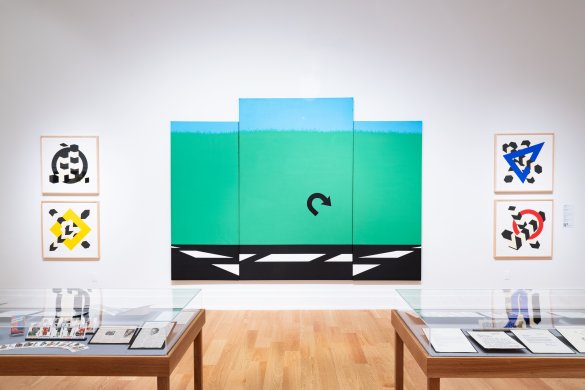
At first, one can understand roads, or the road movie genre, as symbols of freedom, encounters and/or re-encounters, and even as an escape from one's life problems. That was my initial interpretation when visiting Allan D’Arcangelo’s (American, 1930–1998) current exhibition, Allan D’Arcangelo: Landscapes and Constellations, at the Buffalo AKG Art Museum. When first encountering his work and noticing the clear references to roads and highways, water towers, and traffic signs, I assumed D’Arcangelo held a romanticized view on the highway boom in the United States and of Americana imagery. However, after taking time to observe and reflect on his Landscapes and Constellations, my understanding of it shifted. He is not necessarily idealizing highways but rather translating into images what he saw on his own journeys. The signs, road imagery, and water towers are not symbols of greatness but man-made structures that permeate and obstruct the view of a free and open landscape.
Traffic signs, parts of the road, and highway structures appear throughout D’Arcangelo’s work. His screenprints and paintings function as glimpses of what one sees while driving. More figurative in his earlier works and increasingly abstracted in later ones, his pieces focus on details of the landscape. The water towers series, for example, consists of fragments of infrastructure and resembles what one sees when driving past them. They work as slight shifts in perspective of the same object, as if they were stills captured from a driver’s point of view. His work presents fragments of a larger whole, as pieces of the path of a traveler. Yet, while these detailed fragments might be expected to describe a specific place, his images cannot be pinpointed to any particular location.
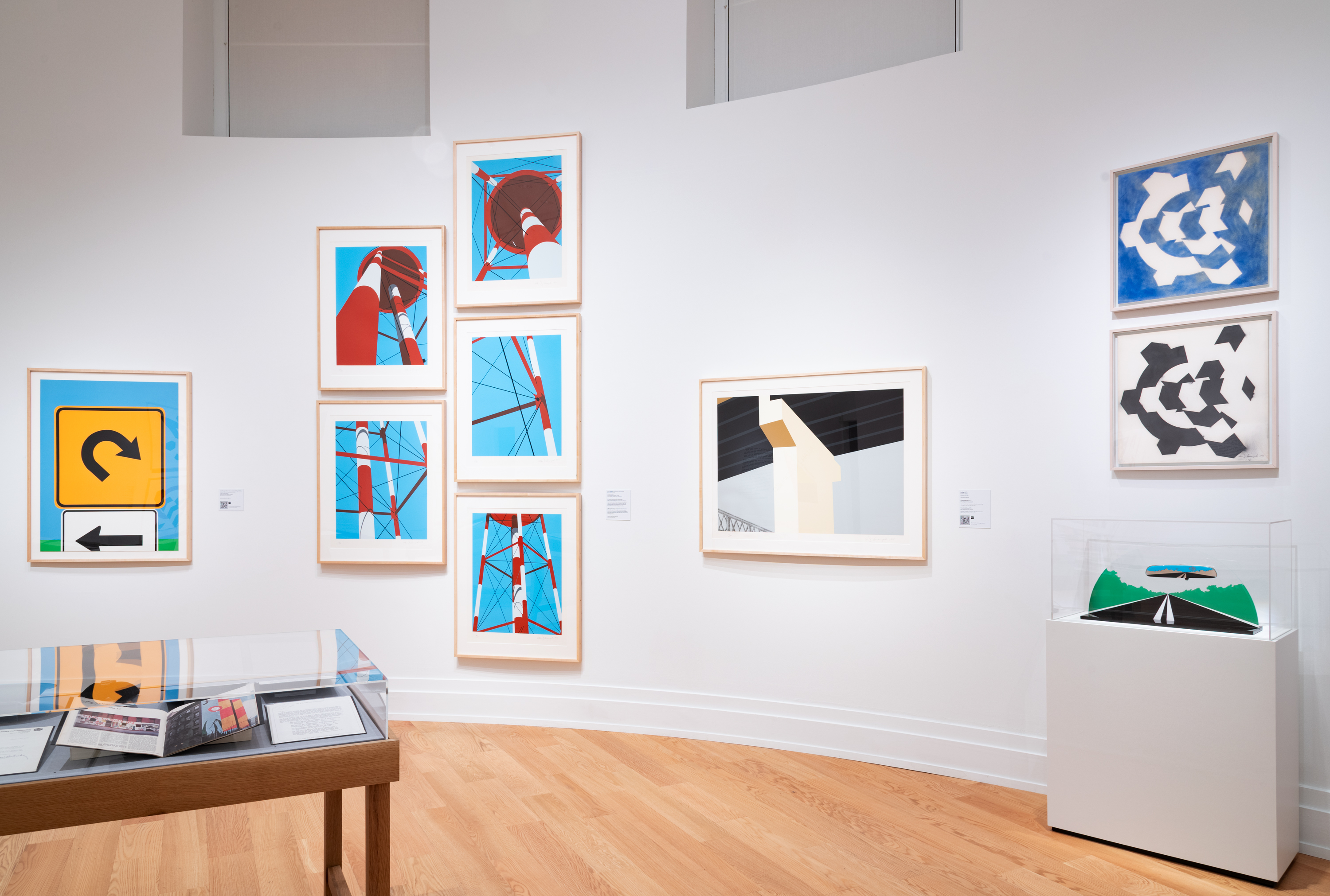
Even though D’Arcangelo traveled to many places, from Los Angeles to Mexico and New York City, we cannot determine the exact location of his images simply by looking at his work. Much like in Paris, Texas, the vernacular American landscape we encounter, such as diners, neon signs, motels, billboards, and gas stations, can be found almost anywhere in the United States. Combined with the economic strategies implemented after the 1929 Great Depression, zoning laws, car-centric urban design, and technological developments following World War II, the urban landscape of this country feels strangely similar across regions.
This massification of infrastructure, in which everywhere begins to look the same, was something that deeply shocked me when I first moved to Buffalo. As a Brazilian immigrant, I was not accustomed to this level of architectural homogenization. Growing up in the most populated city in Brazil, the streets and sidewalks were, for me, always places of movement. Wandering through the streets of São Paulo was a moment of seeing other people, observing the bars and cafes, the commerce, people walking, dancing, talking, selling products, and playing. The public space was busy and lively. Streets were always places of encounter, life, and gathering. Instead of architectural uniformity, vernacular infrastructure should have character and foster human presence. As Camilla Ghisleni writes,
“In Latin America, encounters do not necessarily arise from grand architectural gestures or monumental urban plans. They emerge from the in-between, from intermediate spaces: the courtyard, the veranda, the sidewalk, the shared corridor.”
The opposite sensation came over me when I first moved to the United States. I was baffled by how empty the streets were. Walking the streets of Buffalo felt silent and stagnant. Here, the streets were not places of spontaneous encounters, but an emptied experience. One could argue that the reason might be the city’s cold weather. However, even in warmer cities, like Los Angeles, for example, the dependence on cars and deficiency in walkability creates lifeless public spaces.
The design of the infrastructure confirms it. Houses look incredibly similar, and many stores are located in strip malls, which are highly commercial and lack personal characteristics. A store here in Buffalo could easily be situated anywhere else in the country. Large roads, parking lots, and big box stores: constructions across America that exist everywhere and nowhere at once. Walking around Buffalo for the first time, especially in strip malls and suburban areas, made me feel as though I were inside the film The Truman Show (1998): similar houses all-around and the odd feeling that no one questioned it. As stated in The Truman Show, "We accept the reality of the world with which we're presented. It's as simple as that." It might take an outsider's eye to feel uncomfortable with this familiar condition.
The shock of architectural similarity and intense dependence on cars became one of the main motivations for my thesis during the MFA in Studio Art program at the University at Buffalo. The emptiness of the streets and the presence of abandoned infrastructure are seen, for instance, in my video-performance Contraposed Body. This black-and-white 40-minute video, resulting from performance-based work, investigates feelings of vulnerability and insignificance by placing my body within the margins of pedestrian safety. Through a total of eight actions, each five minutes long, I positioned my body in vast, empty spaces designed for car-centric culture.
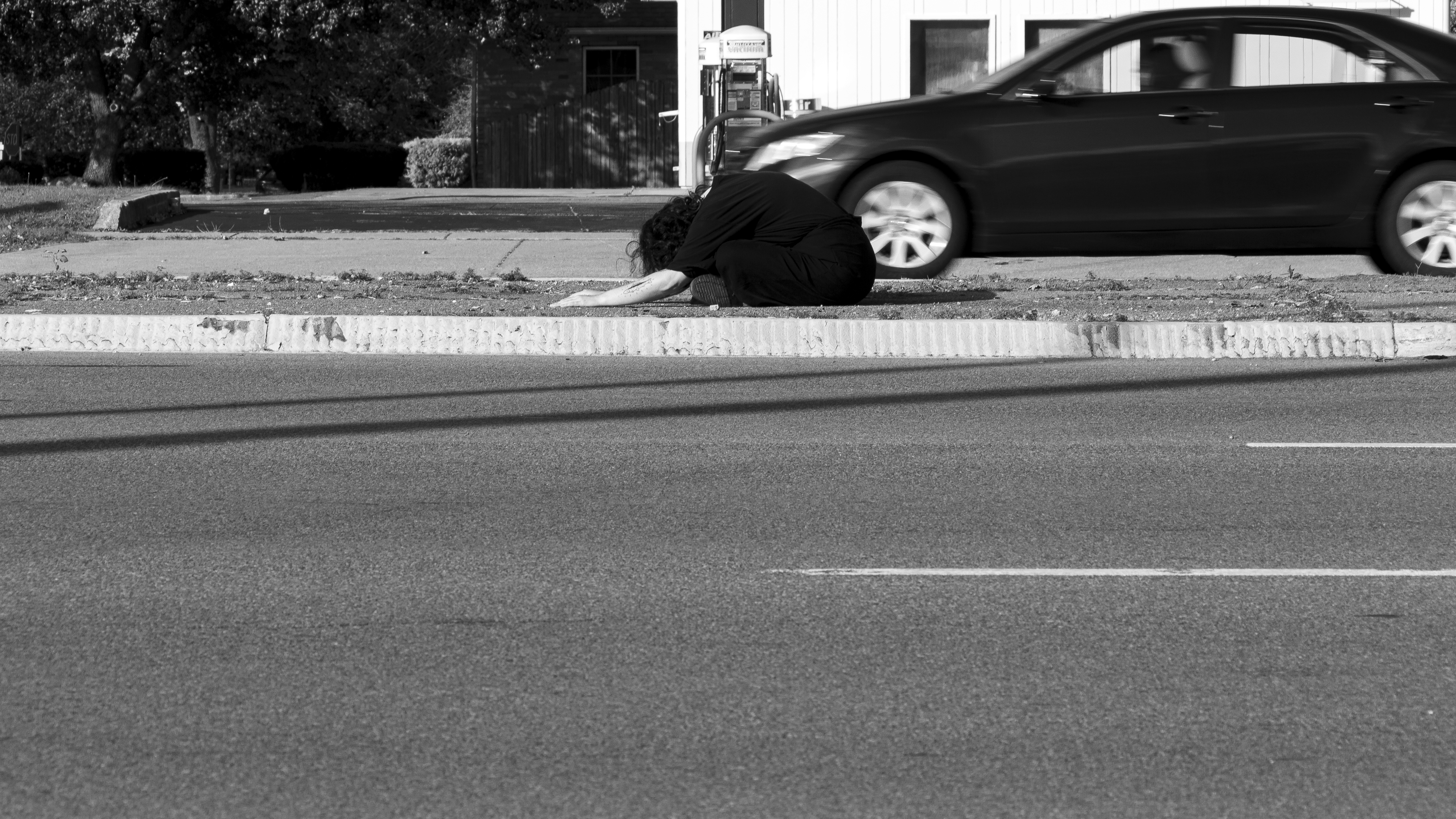
Contraposed Body has a more directly critical point of view than D’Arcangelo’s work. However, the subject I critique is also present in his work, in a more subtle way. As in Paris, Texas, his landscapes are not locatable; they are vernacular structures present throughout the country. Another aspect in common between my thesis, titled Wanderer Phenomenon, and Allan D’Arcangelo’s work is the incorporation of traffic signs within our artworks.
In his work, the signs are observations encountered during his travels, either obstacles blocking his view or man-made structures along his path. In my series Walking Findings, the sign becomes a sculptural element rather than a representation of the sign itself. As a photographic series, the intent behind mounting the images as urban structures within a gallery space was to invite the audience to walk through the installation. In this way, the viewer’s experience mirrors my own image-making process, wandering while slowly observing my surroundings. The images, fragments of architecture, are not documents of a specific place, but consequences of the walk itself. The series, then, proposes a way of occupying urban public space through presence, awareness, and utilizing the act of walking and observing as forms of engagement with the city.
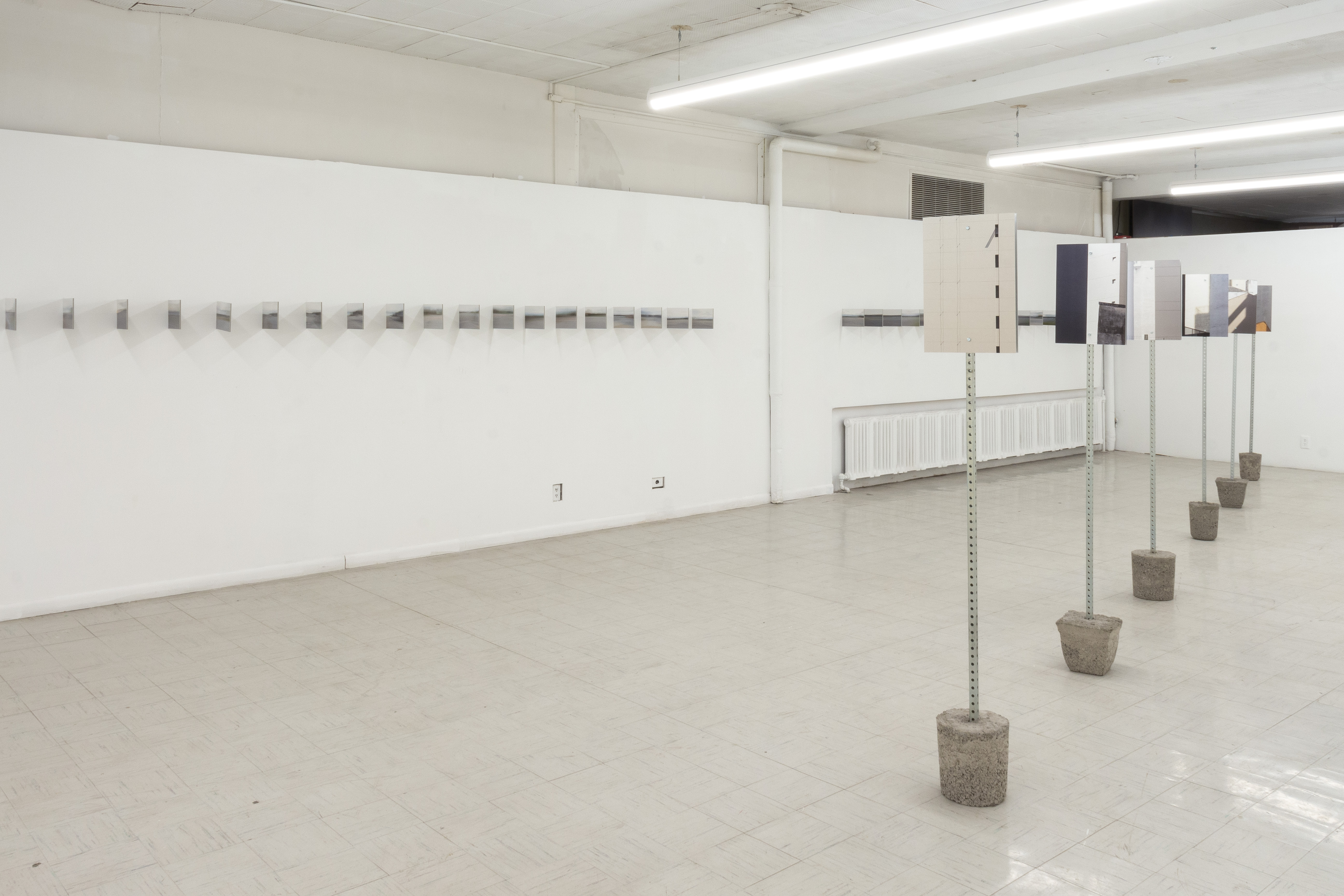
The art-making process itself also reveals points of convergence, since D’Arcangelo and I are both drifters. He drives, I walk. Through our wanderings, both of our artworks emerge from what we encounter along our paths. While the artist of Landscapes and Constellations adopts a more direct approach, representing his findings on the road either figuratively or abstractly, we share a similar method: not a journalistic documentation, but an artistic response to what already exists in the world.
The difference in the critique of the American landscape present in both works, more subtle in his case and more direct in mine, may stem from our backgrounds and perspectives. D’Arcangelo was born and raised in Buffalo, and the obstructions he encountered during his travels were part of the environment he grew up within. For me, as a Latina immigrant, the emptiness of the streets was my greatest cultural shock and profoundly shaped my work moving forward. The resulting critique of American urban design is a result of viewing this country through a different lens, the lens of an immigrant.
In my series of performances, I explore non-spaces such as large roads, empty parking lots, strip malls, and abandoned highway structures. Similarly, D’Arcangelo creates detailed portrayals of places he traveled through that are not specific to any location and remain untraceable. In Paris, Texas, the director Wim Wenders tells the story of the journey of a man and his family. He does so by showing places that could exist anywhere in the United States. Personally, I believe the film extends beyond Travis’s familial relationships; it also functions as a portrait of America. It depicts lonely geographies, alienation, loneliness, and individualism. The lack of distinguishing characteristics in these spaces confirms their detachment and distant impersonality. They exist somewhere and nowhere all at once, just like D’Arcangelo’s landscapes.
About the Author
Ligia Sato is a São Paulo-born artist interested in investigating the urban environment through lens-based media and performance work. Growing up in a densely packed city, with a heavily trafficked avenue as her front yard, made it clear to her from a very young age that one’s immediate environment has a profound impact on both physical and mental well-being.