Skip to Main Content

Ragnar Kjartansson: Politics of the Obvious

Thursday, September 3, 2026Sunday, January 31, 2027

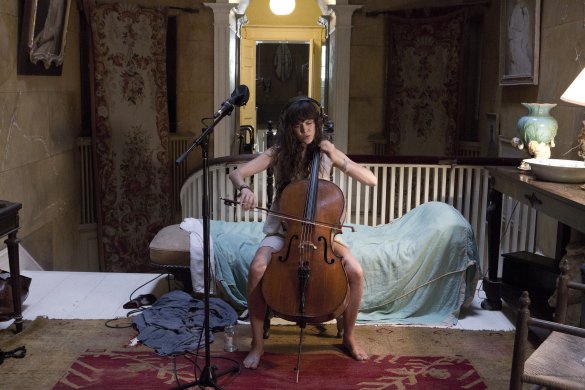
Ragnar Kjartansson (Icelandic, born 1976). The Visitors, 2012. Nine-channel HD video projection; color, sound. Running time: 64 minutes. Courtesy of the artist, Luhring Augustine, New York, and i8 Gallery, Reykjavik. Photo: Elisabet Davids 

Jeffrey E. Gundlach Building
Floor 1

Ragnar Kjartansson works across performance, music, and image to create shared emotional experiences from otherwise commonplace or familiar scenes. Politics of the Obvious is one of the celebrated Icelandic artist’s most ambitious ever exhibitions in the United States and half of the works are making their American museum debut at the Buffalo AKG. The exhibition centers on a series of deceptively simple refrains, clichés, and truisms. In six immersive installations made over more than two decades, Kjartansson transforms such familiar phrases or gestures into experiences that become altogether strange, provocative, and powerfully moving.

Ragnar Kjartansson (Icelandic, born 1976). No Tomorrow, 2022. Six-channel digital video; color, sound, 4/6 plus 2 artist's proofs. Running time: 29 minutes, 18 seconds. Commissioned by Sigurður Gísli Pálmason; based on a commission by the Iceland Dance Company. Courtesy of the artists, Luhring Augustine, New York and i8 Gallery, Reykjavik. Collection Buffalo AKG Art Museum. Bequest of Arthur B. Michael, 2024 (2024:64). 

Ragnar Kjartansson (Icelandic, born 1976). Scenes from Western Culture, The Boat (Stephan Stephensen, Kristín Anna Valtýsdóttir and Gyða Valtýsdóttir), 2015. Single-channel video. Running time: 2 hours, 36 minutes. Courtesy of the artist, Luhring Augustine, New York, and i8 Gallery, Reykjavik 

Ragnar Kjartansson (Icelandic, born 1976). The Visitors, 2012. Nine-channel HD video projection; color, sound. Running time: 64 minutes. Courtesy of the artist, Luhring Augustine, New York, and i8 Gallery, Reykjavik. Photo: Elisabet Davids 

In the video Scenes from Western Culture (The Boat) (2015), for example, an elegantly dressed couple repeatedly and languidly sets off into a tranquil sea; the man stays the same while the woman seems to keep changing. Their evident wealth and ease, coupled with the impossible beauty of their setting, constitute the stuff of glossy travel brochures, the carefully constructed advertising tropes that wallpaper an office worker’s imaginary. Such an unachievably perfect two weeks’ vacation was, of course, a reward designed to help keep that same worker productive during the other fifty weeks of the year. Devoid of drama or incident, Kjartansson’s The Boat embodies the deep-rooted fantasy that leisure (enjoyed through the brief reprieve of a vacation or more durably attained through wealth) will cure what ails us. It illustrates a fiction that is as inherent to modernity as our increasingly digital and monitored working lives. 

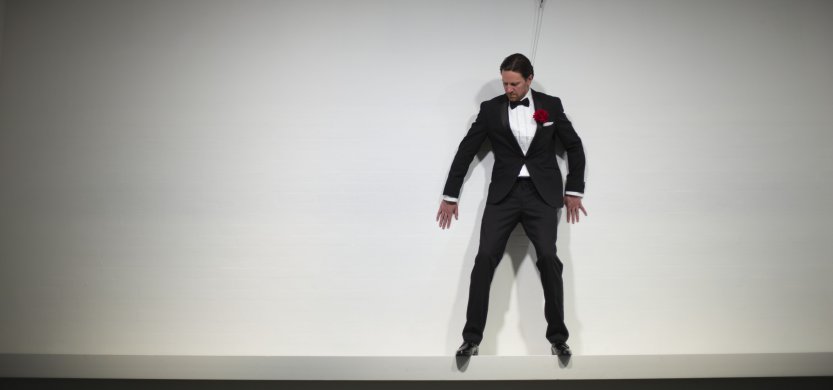
The nearby live performance Bangemand / Scaredman (2023) offers a stark counterpoint to the holidaymakers in The Boat. Every day during the museum’s open hours, a man in a tuxedo inches along a narrow ledge high in a gallery, his body pressed anxiously against the wall. The scenario recalls cinematic tropes—from silent-era physical comedy to midcentury thrillers such as Vertigo (1958)—yet Kjartansson strips the scene of narrative resolution. A clean-cut, suited figure is typically a sign of masculine authority, composure, and control; in Scaredman, he instead appears beset by unseen and undefined forces. The performance evokes a familiar cultural script in which masculinity is cast as under siege, transforming a familiar archetype into a meditation on fear, spectacle, and the troubling logic that power sustains itself by staging its own vulnerability. 

Ragnar Kjartansson (Icelandic, born 1976). Bangemand/Scaredman, 2023. Live durational performance; variable. Courtesy of the artist, Luhring Augustine, New York and i8 Gallery, Reykjavik. Originally presented at the Louisiana Museum of Modern Art. Photo: Louisiana Museum of Modern Art/Poul Buchard 

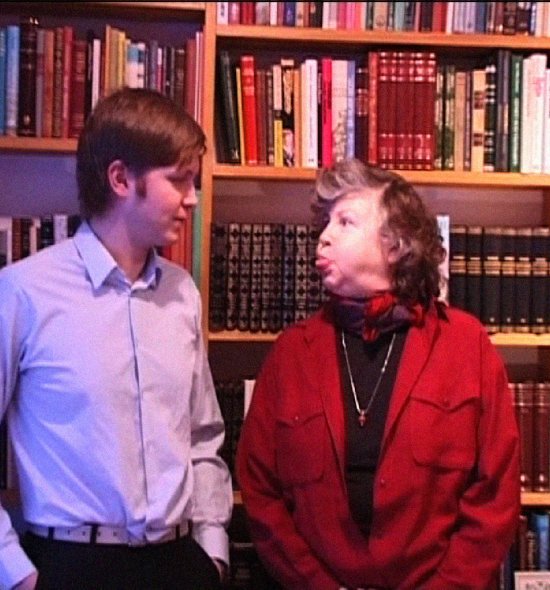
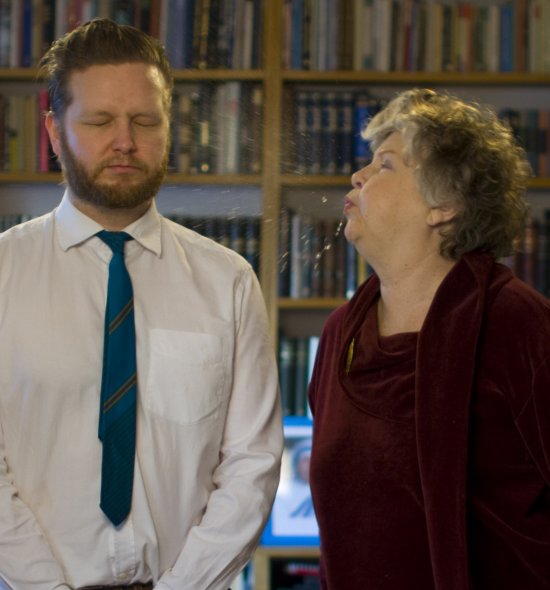
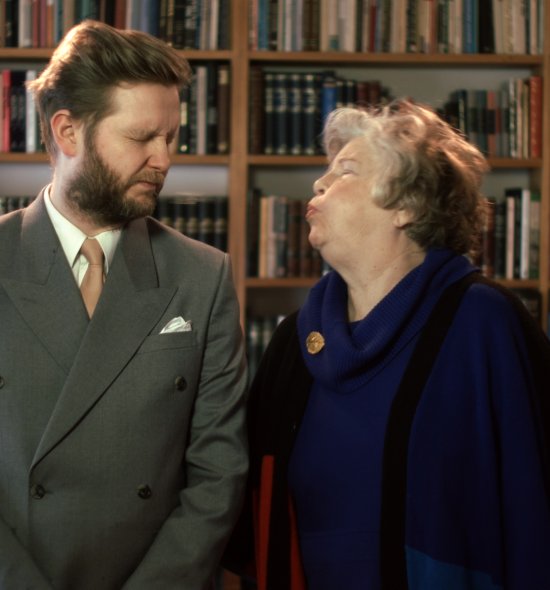
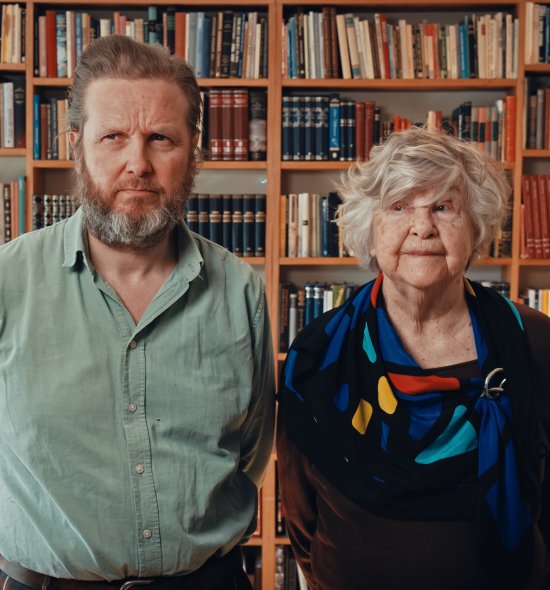
In an interview, Kjartansson has reflected on the importance of holding opposing emotional registers in place: “There is always this balance between irony and sincerity. I think that’s where things become interesting.” This sensibility runs throughout the works in Politics of the Obvious. In Me and My Mother (2000–25), for example, a repeated, confrontational act between mother and son becomes a tender record of time passing. In No Tomorrow (2017), a group of performers with guitars take up historic entertainment repertoires while eventually exposing their artifice, seeming to dance around the fleeting nature of desire itself. The Visitors (2012) is one of the most beloved artworks of the twenty-first century. In the virtuosic installation, musicians each play alone in separate rooms of a decaying mansion in upstate New York. Their voices carry through walls, gradually enfolding a shared refrain and transforming the individual into a temporary collective. Sunday Without Love is a tableau vivant rooted in traditions ranging from romantic balladry to landscape painting that builds into a sustained meditation on loss.  

Kjartansson stands in wonder at the world’s contradictions. “I am just totally in awe of the world and all its mystical beauty and mystical violence,” he has affirmed. Seen together, the works in Politics of the Obvious describe a world in which aspiration and anxiety are tightly bound, with the quest for stability, beauty, and rest shadowed by a persistent sense of precarity. By confronting familiar images throughout the exhibition—of love, masculinity, leisure, and power—Kjartansson reveals their underlying instability and invites us to dwell in what often remains hidden in plain sight.

  • One person spitting water on the other
  • One person spitting water on the other
  • One person spitting water on the other
  • Two people looking forward with stoic expressions

[Above: Ragnar Kjartansson (Icelandic, born 1976). Me and My Mother, 2000–25. Six single-channel videos; color, sound. Running time: variable. Courtesy of the artist, Luhring Augustine, New York, and i8 Gallery, Reykjavik]


Ragnar Kjartansson: Politics of the Obvious is curated by Cathleen Chaffee, Charles Balbach Chief Curator with Helga Christoffersen, Curator, AKG Nordic Art and Culture Initiative. 


Sponsors

Leadership funding for Ragnar Kjartansson: Politics of the Obvious is provided by the Buffalo AKG National Council. Generous support is provided by an anonymous donor. Additional support is provided by Gina & Erik O'Neill and Stephen & Monica Spaulding. Support is contributed by i8 Gallery, Luhrig Augustine, and Ruth Wagner & George Simmons.

This exhibition is supported by the Nordic Art and Culture Initiative, made possible by the leadership support of the Nordic Founding Patrons group.